"Pets vs. Cattle" in the Agent Age
Agents are the new SaaS. I’ve been deploying more and more agents across enterprises, individual family offices, and in my own personal life.
All That Is Old Is New Again
It feels like mobile in 2010. The future is here, it’s just not distributed yet. Just as I was puzzled when companies call themselves a “mobile” or “cloud” startup then, I pause when someone tells me they are creating an “agentic” startup today. “Aren’t almost all new software companies today agentic in some way?” I have to remind myself that not all everyone today talks to AI more than they talk to humans. Those of us on the edge already are living in the future.
All that is old is new again - both opportunities and challenges. Wrangling these new, strange, and amazing pieces of technology that we agents feels like wrestling with Philip Pullman’s living daemons at times. However, eventually these too will become boring technology:1
I’m starting to see an old trope reemerge again in the AI Agent Era: the devops adage of “pets vs. cattle.”
Pets vs. Cattle
“Pets vs. Cattle” is a famous analogy used in cloud computing coined by Randy Bias2 and devOps to explain two different types of server management:
Pets
Pets as a concept treats servers like beloved household companions. They are given individual names like “morton-mail-server” and are carefully nurtured.3 If a pet server gets sick or crashes, it’s all hands on deck. DevOps manually steps in to immediately nurse it back to health, patch it, or troubleshoot the specific issue.
The advantage is a tailored, fine tuned service matured with intimate knowledge of the owner. The disadvantage is a single point of catastrophic failure that is unique and has no immediate, identical replacement.
Cattle
Cattle as a concept treats servers like a herd of livestock in a pasture. They are identified by generic tags or IDs. They are replicable, anonymous, and disposable. If one server fails or has a hardware issue, you don’t spend time trying to mend it. You “take it out back” to terminate it and automatically provision a replacement.4
The advantage is resiliency through redundancy. Your herd can survive with any one or several servers going down. The disadvantages complexity. Raising a single pet is an act of understanding and love. Managing 10,000 head herd is a business operation. It’s simultaneously one for which you need specialized expertise, and which no one person may fully understand when a systemic infection devastate the herd.
Anthropomorphized Agents
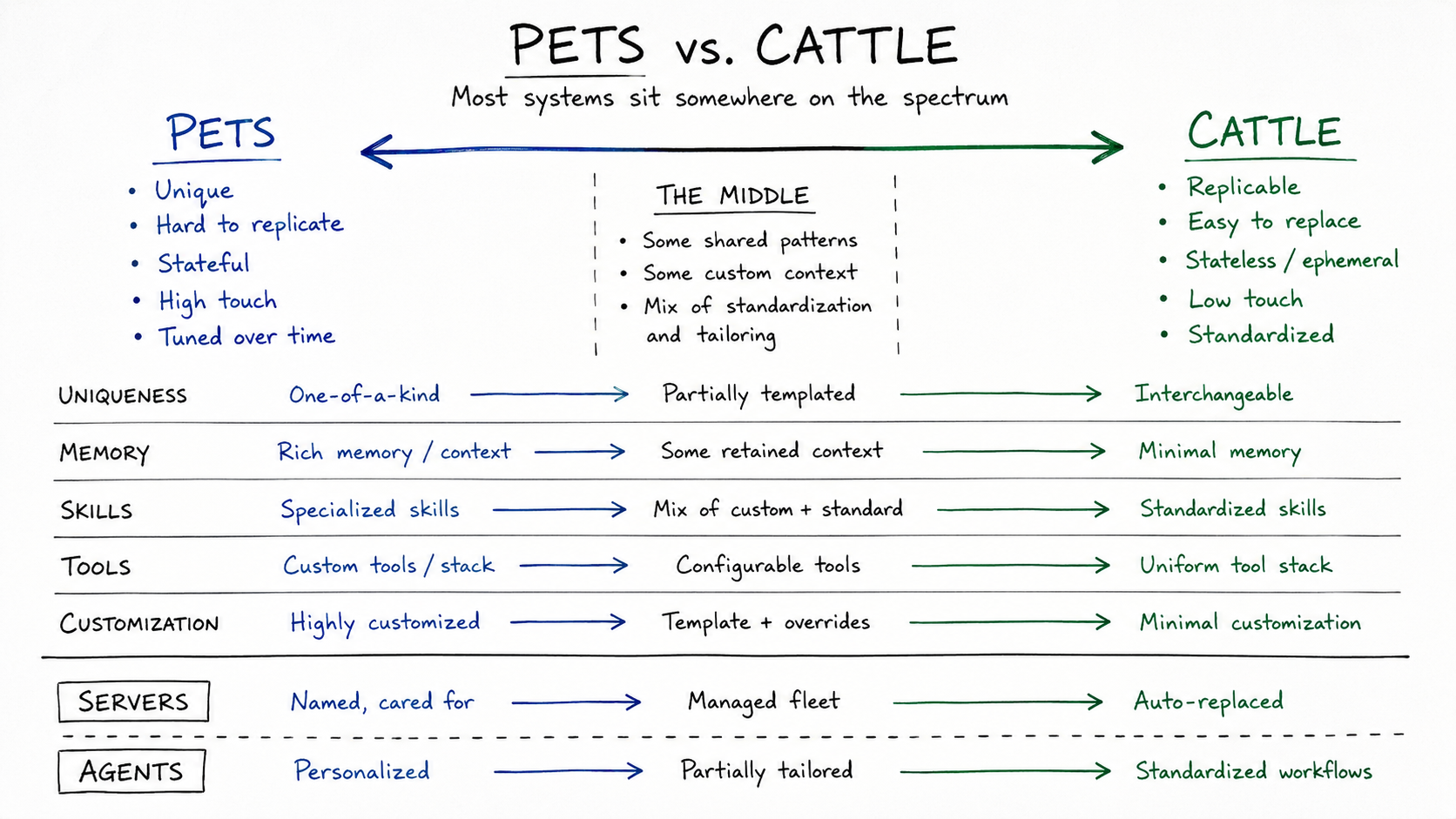
This same analogy can be repurposed for emerging agentic systems:
Pet Companions
On one end, my personal chief of staff agent is a pampered pet. Hundreds of hours spent setting up, tweaking, tailoring, maintaining, and evolving hundreds of skills, crons and customizations. I know it like an intimate companion from its pragmatic, but slightly humorous personality mark down Soul.md to the SSH drop quirk when I over run git update timeouts. It’s become such an intimate part of my daily workflow that when it goes down (or anthropic changes its subscription policy), I have AI withdrawal and scramble to bring my other half back to life.
Semi-Fungible Staff
In the middle, I’ve deployed similar chiefs of staff and function specific agents running internal operations for a number of family offices and mid-market enterprises. It’s a small herd numbering in dozens instead of thousands. I still know the name of every single one of them. Each has its own memory, context, tools, and environment, carefully crafted to its master and corralled by its wrangler (me) down to its own unique icon and personalized name. Each has its own unique personality, and failures still trigger phone calls, but nobody will try if we have to cull a few misbehaving individuals as long as we have timely, suitable replacements.
Herded Workflows
On the other end of the spectrum, I’ve been working with a few enterprises to deploy cattle agents for their customers at scale. With thousands to tens of thousands of agents running externally, you cannot afford to babysit individual pets in the business operation. Any bug, misuse, or flaw is an EBITDA destroying matter liable to become systemic. In their simplest form, these are really stateless or ephemeral state scheduled workflows with calls to LLMs. These workflows are built to very similar to traditional software of the past. Reputable, reliable, deterministic(ish).
Tradeoffs Deploying Agents in Production
Engineering how to get the best of both worlds is an increasingly interesting challenge unique to the Agent Age:
Agent Uniqueness = Value
There is no functional value to a pet server’s uniqueness. Today “pets vs. cattle,” is an overhead trade-off decision: we know most of the best practices to build redundant fleets of cloud server containers and software and organizational systems overhead to fit services to that model. For the most part, we want the same pet functionality, just the ability to clone, recreate, and swap out that pet as many times as we want.
In contrast, an agent’s uniqueness is often precisely what makes it exceptionally valuable. Everyone’s ChatGPT window has access to a GPT API request. Only your OpenClaw agent has access to not just your historical conversation context, but also business workflow skills, crons, custom tools, and more.
Uniqueness = Cost + Risk
OpenAI, Anthropic, and others are quickly adding more claw-like capabilities to their agent platforms, but AI-enabled software development is eating itself and moving faster than ever before. Even if the major AI Labs have the advantages of compute, capital, and talent, and luxury of general purpose usage, software is too fast (and dangerous) to give millions of users unfettered access to a fully customizable agent-driven computer with both the latest open source tools of the last week and the proper guardrails patching Mythos-uncovered security flaws of the last 24 hours.
What Is a CIO to Do?
What are most other companies with narrower resources and scopes to do? Software application development has always been about taking general purpose machines and customizing them with proper guard rails to help a customer to derive value without killing themselves or the service. Agents are opening up a white space new methods, and tools to solve these emerging challenges amongst them:
Questions for the Agent Age
- What are the right barriers between unfettered agent access, and restrictive guard rails?
- How does one balance value in customizability with reliability and security?
- How does one expand non-technical access with standardization versus customizable access to general manipulation?
- How should individual context, memory, and capabilities be stored and customized at scale?
- What does observability and evaluation look like to monitor the behavior of a heterogeneous herd?
- What are the appropriate security models for responsibly stewarding a heterogeneous herd?
- How does one reliably transfer customizations at scale to get new benefits while retaining old value when you architectures emerge weekly?
We Are Just Getting Started
We’re only starting to ask these questions in the software industry, and those of us at the cutting edge are only just beginning to formulate our initial answers. As in most cases, “it depends.” But this time, not just on the specific business situation, but also on last week’s latest open source agent release.
Exciting challenges for exciting times. Eventually this too will pass and such things will be boring again, but for right now solving them might be some of the most important work happening in software today.
More Questions?
If you’re tackling these challenges or this resonates and want to chat more about them, reach out!
In the Agent Age, intelligence is cheap, but insight is invaluable. At SVI, we're taking many of the things we learned being born in the mobile age and teaching organizations how to apply them to the current one. Always enthusiastic to mind-meld with those at the cutting edge and help empower those looking to get there.5
Footnotes:
[1] See Dan McKinley's presentation "Choose Boring Technology."
[2] Randy Bias adapted the analogy for cloud from a Scaling SQL Server presentation by Microsoft Distinguished Engineer Bill Baker. With a nod to Randy's request, I'm referencing his original post to continue the chain of alegoric adaptation.
[3] See my thoughts on Commercial Opportunities in a Renaissance of Self-Hosting catalyze by AI.
[4] The cattle analogies run deep. See "Rancher" a popular enterprise management system for distributed computing software Kubernetes.
[5] See The famous quote by author William Gibson, "The Future is already here - it's just not very evenly distributed."